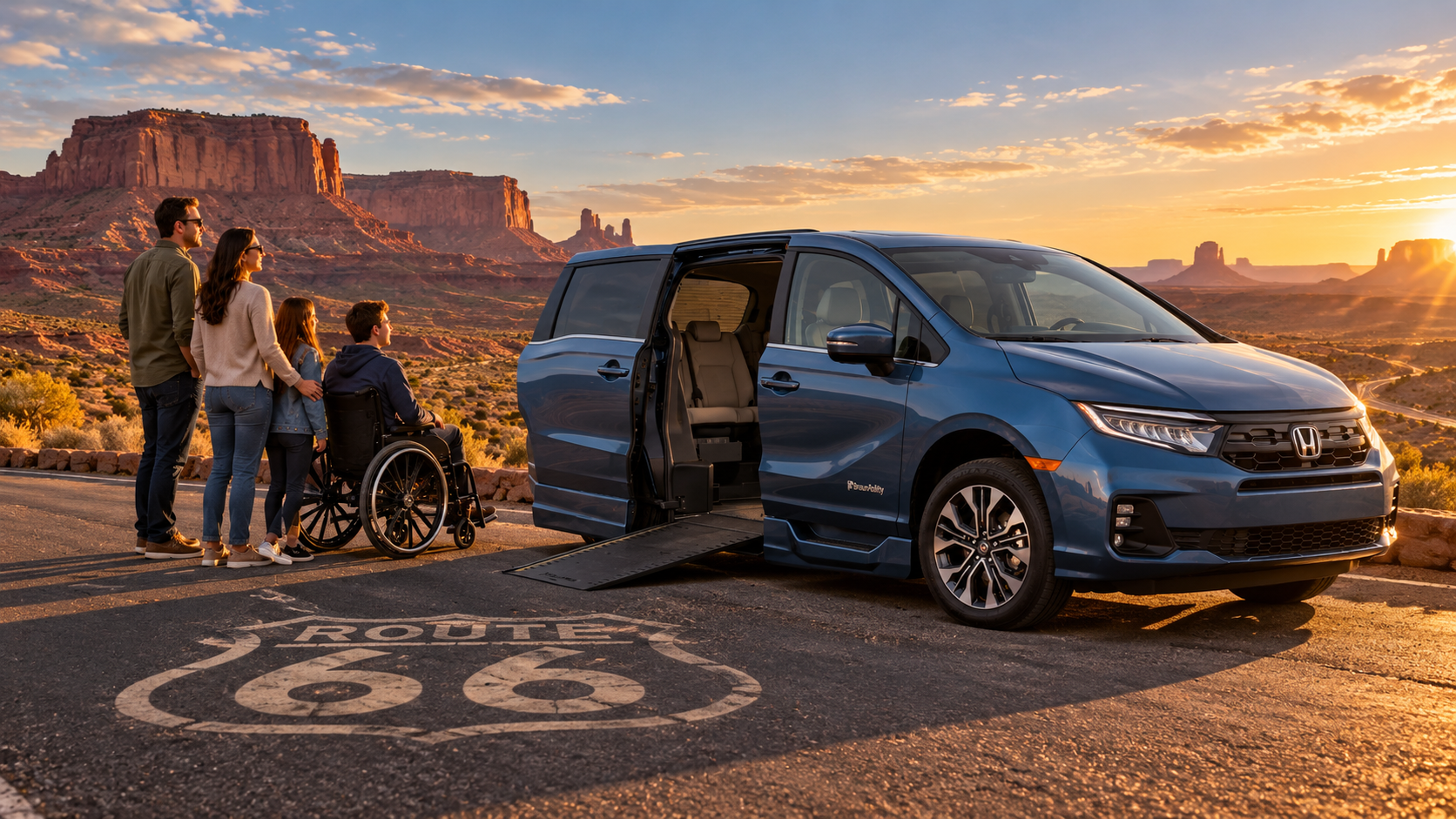
Few highways capture the spirit of American adventure quite like Historic Route 66. Stretching from Chicago to Santa Monica, the “Mother Road” winds through some of the Southwest’s most breathtaking and sun-drenched landscapes. You can spend the morning staring into a meteor crater, pose with an enormous jackrabbit after lunch, and end the day underneath a motel sign glowing pink and turquoise against the desert sky.
The issue is, Historic Route 66 was built long before curb cuts and modern entrance standards, so access can change dramatically from one block to the next. This guide focuses on accessible Route 66 roadside attractions you can genuinely plan around, while clearly noting the famous stops that still have access limitations.
Top Barrier-Free Route 66 Attractions Across the Southwest
Exploring the Southwest section of Route 66 offers a rich mix of outdoor art installations, natural wonders, and mid-century Americana designed for easy vehicle-based and roll-in sightseeing.
Cadillac Ranch (Amarillo, TX / New Mexico Border)
Just off Route 66 near the Texas-New Mexico border, Cadillac Ranch is one of the highway’s most famous public art installations, featuring ten spray-painted Cadillacs buried nose-down in the desert soil.
The site features a dedicated, paved parking lot with van-accessible spaces. A flat, hard-packed pathway leads from the parking area directly to the viewing perimeter, allowing manual and power wheelchair users to roll right up to the artwork to take photos or add their own creative touch using spray paint.
Blue Swallow Motel & Central Avenue (Tucumcari & Albuquerque, NM)
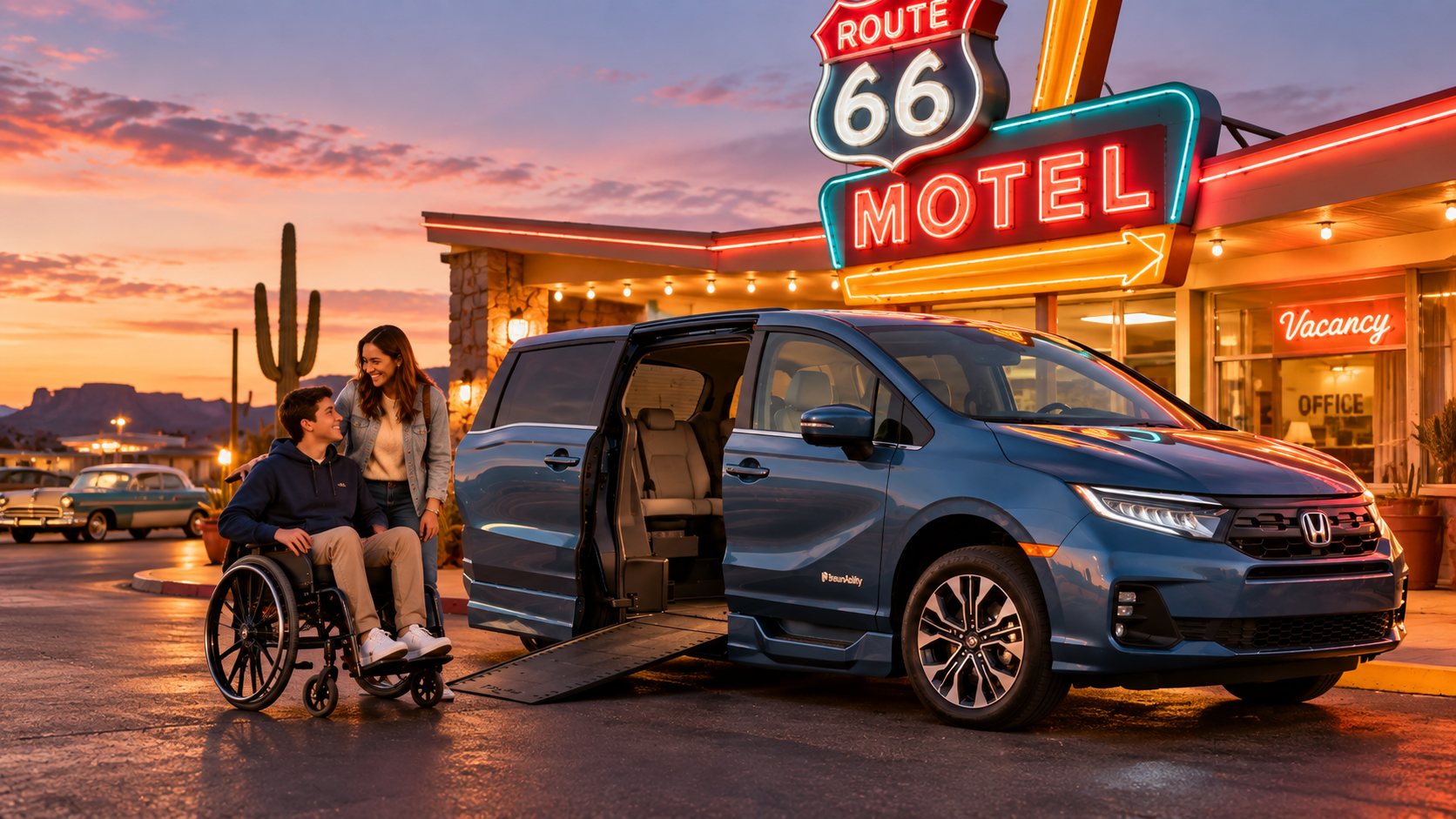
New Mexico holds some of the best-preserved urban stretches of Route 66. In Tucumcari, the iconic Blue Swallow Motel features flat asphalt courtyards where travelers can park directly in front of classic 1950s neon signs for nighttime photo opportunities.
A few hours west, Albuquerque turns Route 66 into a city experience along Central Avenue. Over here, the Mother Road runs past old theaters, neon signs, diners, motels, murals, and trading posts, so there is plenty to see without treating every stop like a separate expedition. Many sections have smooth sidewalks, wide curb cuts, and street-level entrances, making it easier to hop between photo stops and historic storefronts.
Jack Rabbit Trading Post & Meteor Crater (Winslow & Meteor City, AZ)
After enough roadside billboards teasing “HERE IT IS,” not stopping at Jack Rabbit Trading Post feels almost rude.
The Joseph City trading post sits right on Historic U.S. 66 and still serves up the kind of gloriously unserious roadside photo opportunity this trip needs. The stop has level asphalt parking and a step-free approach to the famous roadside mascot, making it an easy place to stretch your legs and break up the drive.
Just down the highway near Winslow, Meteor Crater features a state-of-the-art visitor center perched on the canyon rim. The site provides dedicated van-accessible parking, elevator access to all indoor display galleries, and a flat, paved outdoor observation deck offering panoramic views of the crater.
Not every outdoor route is equal. Moon Mountain involves a sharply rising sidewalk, while the Lower Ramada is reached by steps. The rugged rim experience can also involve sloped or uneven surfaces. Plan around the main viewing areas for the best experience.
The Neon Museum (Las Vegas, NV Loop)
If you are building a longer adaptive van Route 66 travel itinerary, the Neon Museum in Las Vegas is a fun detour. The outdoor Neon Boneyard is packed with towering casino signs, giant letters, old motel marquees, and faded bulbs from Vegas landmarks that disappeared decades ago.
The Boneyard pathways are wide and relatively level, with a fine-gravel surface for easy navigation. Go later in the day if you can. The desert heat eases up, the signs photograph beautifully, and you get the full effect of seeing vintage neon against the evening sky.
Mob Museum (Las Vegas)
The Mob Museum offers even simpler access on your handicap-accessible Southwest road trip. It has four accessible parking spaces, a front lift that bypasses entrance steps, elevator access to every floor, and loaner wheelchairs available free on a first-come basis.
Inside, you’ll work your way through old mugshots, wiretap equipment, organized-crime stories, courtroom exhibits, and enough mob memorabilia to make you briefly suspicious of everyone wearing a fedora. It feels like walking into a very well-documented crime story.
Retro Diners & Vintage Main Streets: Navigating Historic Architecture
When traveling through Route 66, a big part of the trip is pulling over for a classic milkshake, burger, or slice of pie at a vintage roadside diner. However, you should conduct a pre-stop verification for a smooth dining experience.
Evaluating Entrance Thresholds and Table Clearances
A restored 1950s diner can look wonderfully authentic right up until the “authentic” part turns out to include a three-inch threshold and fixed booths.
Look for diners that have added low-incline wooden or aluminum ramps alongside their original entrances. Once inside, classic fixed booths can be tight, so a restaurant with sturdy movable tables and freestanding chairs is usually the better find. You can roll directly up to the table, settle in comfortably, and focus on the important Route 66 decisions, like whether ordering a burger and a milkshake technically counts as historical research.
Historic Curb Cuts and Sidewalk Boarding
Old downtowns can change block by block. You may have a beautiful curb cut at one intersection, broken pavement at the next, and a delivery truck sitting exactly where you planned to deploy the ramp because Route 66 likes keeping things interesting.
When parking along historic main streets in towns like Gallup, NM, or Kingman, AZ, look for smooth, ADA-compliant curb cuts and tactile paving. This ensures a safe, level transition from your vehicle’s ramp directly onto the main sidewalk strip without navigating high vintage granite curbs.
Like what you’re reading? Subscribe to our newsletter and get new updates directly to your inbox.
Desert Vehicle Staging & Highway Climate Control
Driving across the Southwest desert during summer and autumn requires paying close attention to radiant heat and long stretches of open highway between towns.
Asphalt Heat & Crosshatched Parking In Old Town Lots
Ambient temperatures along the Southwest desert corridor regularly reach 90°F to 100°F, causing dark asphalt parking lots near roadside stops to exceed 135°F.
When pulling into vintage attraction lots, look for paved spaces with painted crosshatched buffer zones. These striped zones provide the physical clearance required to deploy a side-entry or rear-entry ramp safely onto flat concrete approaches.
If a historic lot has tiny spaces and no workable aisle, a passenger drop-off followed by separate parking may be much easier than trying to force the van into a bad setup.
Secondary Climate Control for Long Highway Stretches
Long desert driving stretches, such as the two-hour run between Flagstaff and Kingman, demand continuous cooling.
If you are renting a conversion minivan from Wheelchair Getaways for your Route 66 road trip, verify that your assigned model features independent rear multi-zone climate control. Secondary climate systems let rear passengers adjust their local airflow independently, keeping everyone relaxed and comfortable throughout the journey.
This is also the time to fuel up, charge devices, refill water, and confirm your next accessible restroom. Route 66 rewards spontaneity, but the desert is not where you want spontaneity to involve a low fuel light.
Route 66 Travel Readiness Checklist
Review this quick operational checklist before setting out on your Southwest Mother Road adventure:
- Offline Route Downloads: Download digital route maps to your smartphone 72 hours early to ensure seamless navigation through remote desert cell-dead zones.
- Diner Pre-Calls: Call historic roadside diners ahead of time to confirm ramp entries and movable table availability.
- Hydration Planning: Pack a portable cooler with fresh water and electrolytes, staged in the mid-cabin floor space within arm’s reach.
- Ramp Clearance Audit: Verify whether side-ramp or rear-ramp deployment works best for angled main-street parking spaces along your route.
- Mobility Equipment: Charge power chairs and other devices overnight and keep charging cables within reach rather than buried under luggage.
- Shadow & Sun Protection: Pack wide-brim hats, lightweight lap covers, and sunscreens inside the vehicle cabin for roadside photo stops.
- Backup Stops: Save at least one accessible fuel, restroom, or meal option between major towns in case the charming vintage place is closed.
Plan Route 66 Trip with Wheelchair Getaways
The Route 66 trip is all about spontaneity. A five-minute photo stop becomes 40 minutes because somebody starts talking to the motel owner. A giant rabbit suddenly deserves its own photoshoot. You miss one diner and stumble across a neon sign you like better anyway.
If you need a vehicle for the trip, Wheelchair Getaways offers wheelchair-accessible modified vans featuring lowered floors, ramps/lifts, and wheelchair securement options for a safe ride.
Check vehicle availability early for a multi-state trip, review the current deals and discounts before booking, and confirm ramp dimensions against your wheelchair. Fill out the rental quote form or contact the team at 855-419-4335 to reserve your van.