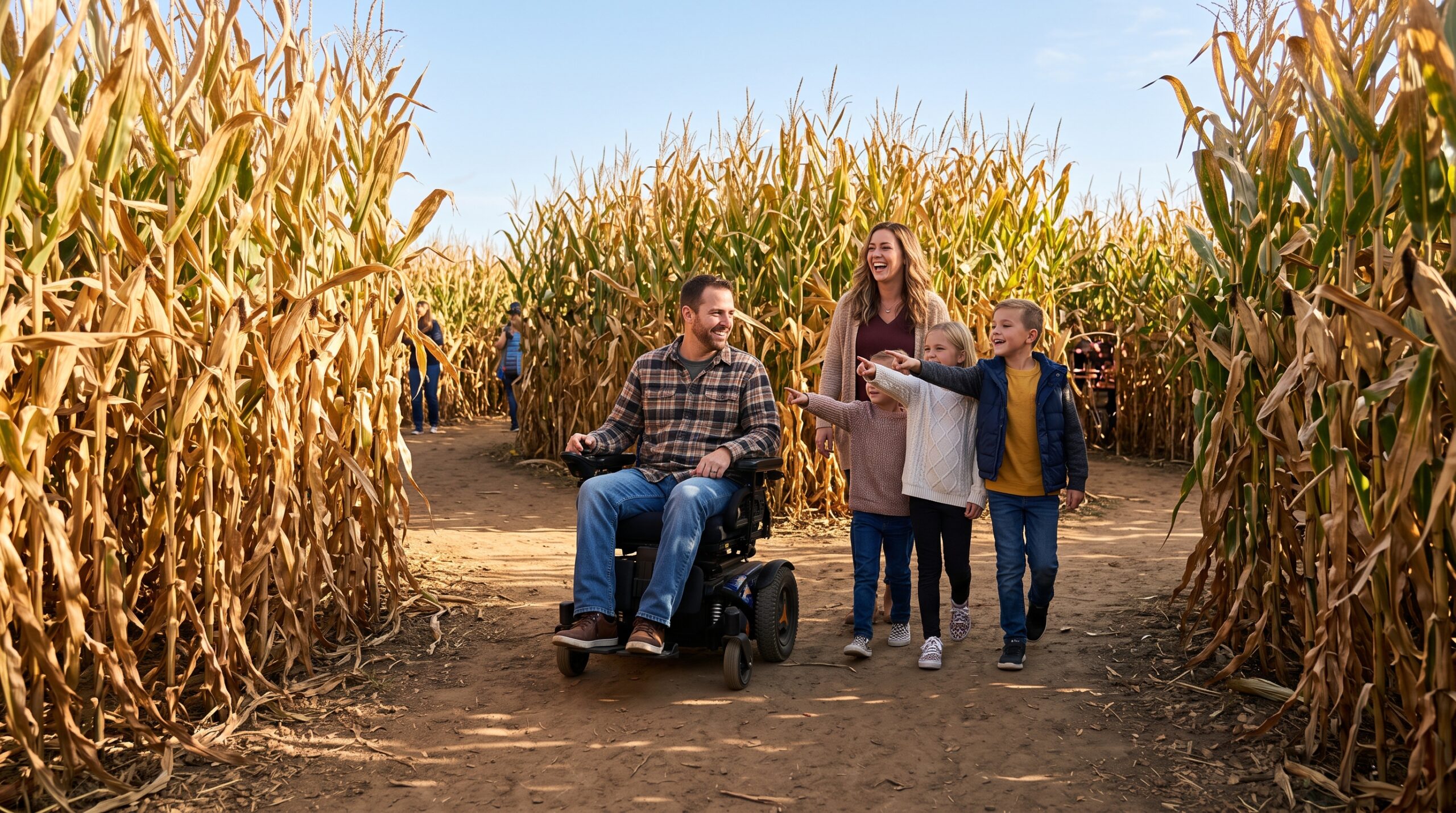
Fall traditions are wonderful. We happily get lost in cornfields, pay for pumpkins we could buy at the grocery store, and somehow convince ourselves apple cider doughnuts taste better when eaten beside a tractor.
But for wheelchair users, gravel parking areas, uneven dirt paths, slippery straw, and old-fashioned wagons can make getting around much harder than cheerful festival photos suggest.
A farm might advertise wheelchair accessibility, but that doesn’t tell you whether its corn maze has deep ruts, whether the hayride has a lift, or whether the accessible parking space is actually a grassy field.
This guide covers the questions worth asking about accessible pumpkin patches, corn mazes, the American farms making autumn activities more wheelchair-friendly, and the practical details that can make your pumpkin-picking adventure considerably less messy.
5 Essential Questions to Ask Before Driving to a Farm
Accessibility at a working farm often varies from one attraction to another. The entrance might be paved while the corn maze is muddy, or the restrooms might be accessible while the hayride isn’t.
Here’s what to ask before you go:
1. Is Parking Paved or Hard-Packed Near the Main Gate?
A lot of farms list “handicap accessible fall festival parking” and stop there. However, accessible parking means more than having a blue sign somewhere near the entrance. You need enough space to deploy a ramp, unload comfortably, and reach the farm without crossing difficult terrain.
Ask the organizer:
- What’s the surface? Asphalt is ideal. Packed gravel works if it’s level. Grass is fine dry but treacherous when wet.
- Can we park on firm, level ground close to the main entrance? A ramp deployed on a sideways tilt makes for a wobbly ride down, especially in a heavy power chair.
- How much room is beside the space? A side-ramp van needs about 8 feet clear beside it, the same as a standard van-accessible aisle. A rear-entry van needs similar room behind it.
- Are there marked van-accessible spaces with adjoining access aisles? A perfectly placed parking space becomes useless when somebody decides its striped area looks like a convenient place to leave a wagon.
- Does accessible parking change on busy weekends? Some farms use overflow parking in grassy fields during busy October weekends.
If you’re arriving in a wheelchair van for rent, ask if there’s a drop-off point on the hard road by the barn or farm store. Plenty of farms will let you unload there, then park the van in the field, even if no sign says so.
2. What Is the Primary Pathway Surface Inside the Maze and Patch?
A farm’s website might describe its trails as “natural,” which sounds charming until you realize natural could mean anything from firm earth to ankle-deep mud.
Packed, dry soil is often manageable for many wheelchairs. Loose woodchips, deep straw, wet clay, and heavily rutted tractor tracks are another story.
Ask specifically about:
- Packed dirt: Is it firm and relatively smooth or full of tire ruts?
- Gravel: Is it compacted crushed stone or loose stones that shift under wheels?
- Straw and mulch: Are they decorative coverings or thick layers across the entire route?
- Mud: Does the farm close or redirect visitors when pathways become saturated?
Don’t forget the pumpkin field itself. Some farms have relatively smooth display areas near the entrance but expect visitors to cross plowed rows to pick pumpkins.
Here’s a particularly useful question: “Can someone using a power wheelchair reach the actual pumpkin-picking area without leaving a firm path?” If the answer is no, ask if staff can bring a selection of pumpkins to an accessible display area, so you can still inspect your future jack-o’-lantern without the off-roading.
3. Are the Corn Maze Trails Wide Enough for Power and Manual Chairs?
A corn maze should challenge your sense of direction, not your ability to make a three-point turn.
For planning purposes, ask whether the paths maintain at least 36 inches of clear width. A wider 48-inch route may be more comfortable, but neither measurement guarantees a wheelchair can turn around at a dead end while a nine-year-old in a cape yells “THIS WAY.”
Ask whether intersections and turnaround areas provide enough room for your chair’s actual turning requirements. Many power chairs need substantially more maneuvering space than a straight path provides.
Other questions worth asking:
- Are there exposed roots, deep tire tracks, or drainage channels?
- Are narrow sections avoidable?
- Where are the emergency exits or bailout paths?
- Can staff provide a map or guide visitors out if conditions become difficult?
A useful trick: Ask for a recent photo or short video of the maze entrance and pathways. It’s often more informative than a dozen reassuring descriptions.
And don’t assume a stroller-friendly maze automatically works for wheelchairs. A lightweight stroller can sometimes be lifted over a rut. A 300-pound power chair is a different story entirely.
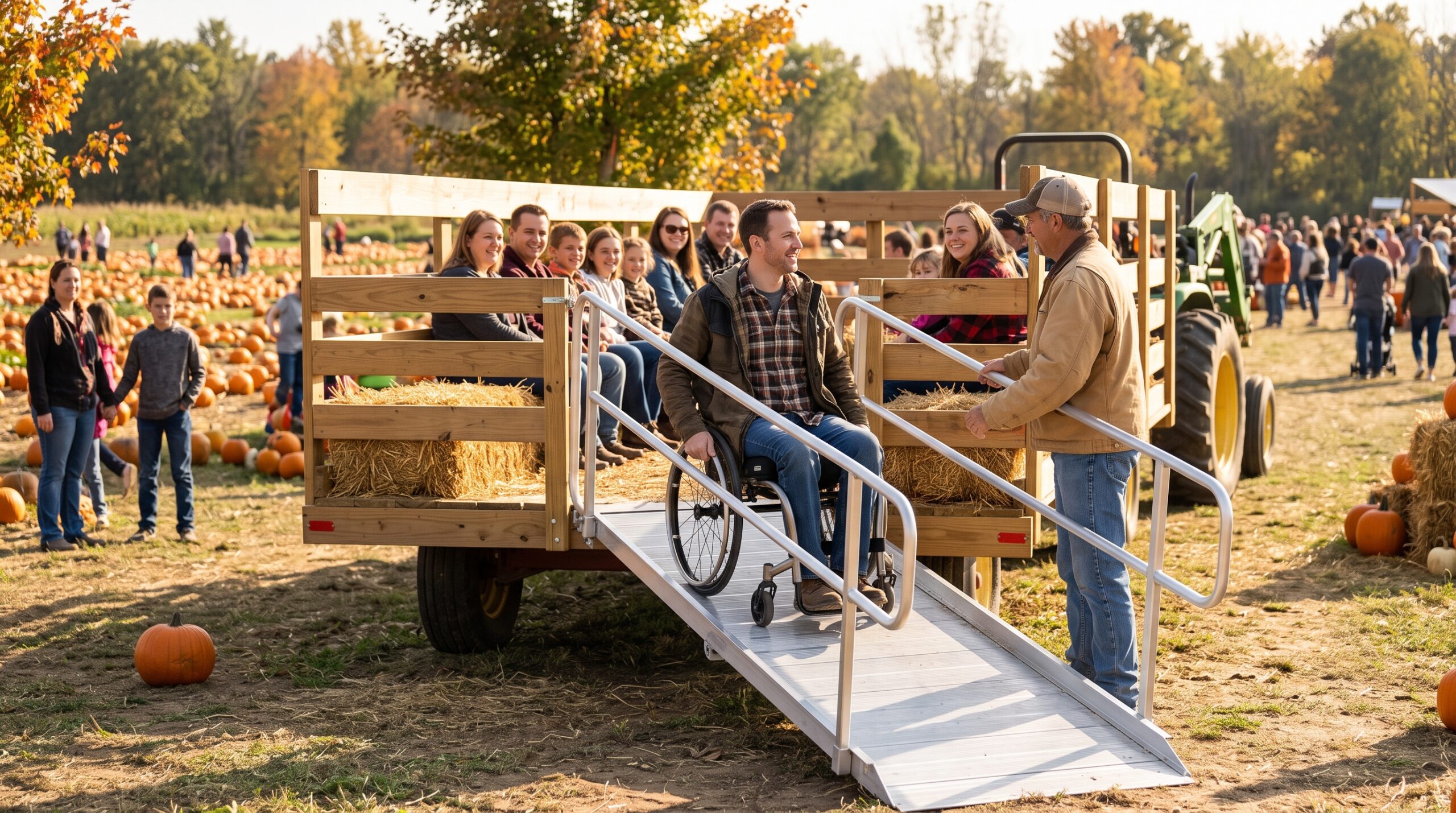
4. Does the Venue Offer Step-Free Hayrides or Adaptive Transfers?
Hayrides are practically a fall requirement. Unfortunately, traditional tractor-pulled wagons are often accessed by narrow steps, with hay bales serving as seats.
For wheelchair users interested in wheelchair accessible farm tours, you should ask exactly how boarding works.
Find out whether the farm has a ramp or mechanical lift, whether the wheelchair can remain occupied during the ride, and how the chair is secured once aboard. Inquire about the lift’s weight capacity, including the combined weight of the person and mobility device.
Some farms offer an accessible wagon only at scheduled times or by advance arrangement. It’s often one wagon cycling through the day, so reserve a time slot.
5. Are Accessible Restrooms Located Near Main Activity Hubs?
Nothing puts a damper on an autumn adventure quite like discovering that the only accessible restroom is on the opposite side of a 20-acre farm.
Most farms rely on accessible portable units, which typically give you about a 5-by-5-foot interior. They’re workable, but placement matters more than the unit itself.
Ask these:
- Is it on a pad or on grass? A unit sitting on soft ground often has a lip at the door.
- Does the door face a path or the field?
- How far is it from the maze entrance?
- Is there a permanent restroom in the farm store or barn? It’s usually roomier and actually has a sink.
If possible, use the restroom before the maze. Mazes take 45 minutes to an hour, and there’s no shortcut to make it to the bathroom!
Like what you’re reading? Subscribe to our newsletter and get new updates directly to your inbox.
Top Accessible Farm Destinations & Harvest Attractions Across the US
Some American farms do a much better job explaining accessibility, rather than leaving visitors to decode the phrase “all are welcome.”
If you’re looking for accessible pumpkin patches and corn mazes across the USA, these destinations are worth considering, although accessibility varies by activity and current ground conditions.
Midwest & East Coast Agritourism Flagships
Blackberry Farm, Aurora, Illinois
Blackberry Farm turns into one long pumpkin party called Pumpkin Weekends every October. Admission covers unlimited rides on the train, carousel, and hay wagon. Pick a pumpkin from the patch and decorate it in the Carriage Museum next door. Weekends bring special events like the World’s Tallest Scarecrow and a balloon artist.
For hayride access, the custom wagon has a side-loading hydraulic lift and four chair anchors, so you ride in your own chair, with bench seating for companions.
Schuster’s Farm, Deerfield, Wisconsin
Schuster’s Farm packs in more than 70 attractions near Madison, WI. The headliners are an 8-acre corn maze and a wagon ride out to a 14-acre pumpkin patch. The large maze is split into two phases, so you can regroup halfway.
Expect pig races, goat feeding, and apple cannons, which are exactly as fun as they sound. The food alone justifies the drive: cider donuts, hand-dipped caramel apples, farm-made pumpkin cake, and kettle corn.
The wagon has a wheelchair lift. In 2024, the farm also moved its haunted attraction into the corn maze for one night, so wheelchair users could take on the scares.
Pine Creek Seed Farm, Pennsylvania
If your family has a competitive streak, Pine Creek Seed Farm might become your favorite autumn outing. Its enormous 19-acre corn maze is wheelchair-accessible and takes roughly 45 to 90 minutes to complete, depending on your navigation skills and how confidently someone insists they know a shortcut.
Weekends bring live music, local food vendors, games, and themed events. Visitors looking for something spookier can check out the special nighttime haunted maze events. However, you should confirm the maze’s current surface conditions and available turning space separately.
West Coast & Sunbelt Fall Destinations
Cherry Acres, California
Cherry Acres is not your average pick-a-pumpkin-and-go-home destination. This Bakersfield farm combines a four-acre corn maze with pumpkin picking, sunflower fields, friendly farm animals, food trucks, and seasonal vendors.
Its sunflower fields offer a colorful backdrop for fall photos, while the evening attractions take a slightly more mischievous turn. The farm also offers a scarier maze for visitors who prefer their Halloween outings with a few extra screams.
For its 2026 season, the farm says it is wheelchair- and stroller-accessible, with ample parking and seating, so you can enjoy your accessible pumpkin patch tour.
Andelin Family Farm, Sparks, Nevada
Andelin’s 5-acre corn maze doubles as a history lesson. It’s themed around Nevada mining, with facts to discover along the way. Night visits are allowed, so bring flashlights and turn it into a spooky scavenger hunt.
The paths are hard-packed dirt and listed as wheelchair accessible. Rain can turn them muddy, so aim for a dry stretch.
Chatfield Farms, Littleton, Colorado
Run by Denver Botanic Gardens, Chatfield Farms’ 7-acre corn maze takes about an hour, with plenty of dead ends to keep things honest. Afterward, you can head to Deer Creek Discovery, the wildlife observation area, or the barnyard animals. Kids’ maze tickets include barrel train rides.
The dirt maze paths are wide enough for wheelchairs but can get rutted after bad weather. Some areas of the farm need assistance, and the farm notes not every area is accessible without help.
Staging Your Vehicle for Farm Terrain & Post-Fun Clean-Up
A good farm day begins before you reach the pumpkin patch. Choosing the right van, loading your equipment, and planning where to park can make the outing much easier.
Matching Side-Ramp and Rear-Ramp Vehicles to Rural Parking Lots
Planning adaptive vehicle fall road trips means considering more than the farm’s location. You also need to know where you’ll unload once you arrive.
A side-entry wheelchair van works well with a wide, level parking space and a clear access aisle. Rear-entry vans can be a useful alternative when side clearance is limited, but they still need adequate space behind the vehicle.
Don’t deploy either configuration on unstable mud, steep slopes, or loose ground without confirming it’s safe.
When searching for a “wheelchair van rental near me”, consider the following:
- Ramp position: Match the side- or rear-entry layout to your expected parking arrangements.
- Wheelchair dimensions: Confirm entry clearance, interior headroom, and compatibility with the wheelchair securement equipment.
- Passenger space: Check seating for family members and available room for strollers, bags, and mobility equipment.
- Rental arrangements: Confirm pickup and return times, mileage allowances, and any schedule-change policies before you commit.
One underrated tip? Ask about vehicle height if your journey includes parking garages or covered entrances. Some wheelchair-accessible vans have raised roofs, and low-clearance structures are not especially forgiving.
Protecting Vehicle Interior Flooring from Mud and Straw
Pumpkin patches can send half the farm home with you. Mud collects in wheelchair tire treads, straw gets trapped around casters, and tiny pieces of dried corn somehow end up everywhere.
Before your trip, ask the rental provider whether protective rubber mats or removable floor coverings are permitted. Avoid covering wheelchair securement tracks, belts, or other safety equipment.
Pack a small cleanup kit with microfiber towels, a soft brush, wipes, and a sealable bag for muddy accessories. Before loading, remove large clumps of dirt from wheelchair tires and check that the ramp surface is free of straw or debris.
Don’t forget to designate one bag for muddy belongings. Otherwise, your vehicle may smell like a festive barn for the rest of the weekend.
Pre-Trip Farm Outing Readiness Checklist
A quick final check can prevent an unnecessary return trip, especially when visiting a farm that’s an hour or more from home.
- Check recent weather conditions: Look at rainfall over the past 24–48 hours because corn mazes stay muddy a day or two longer than open fields.
- Call the farm with the five questions: Ask about parking, path surfaces, maze width, hayride access, and restroom placement.
- Reserve accessible activities in advance: If you’re planning a hayride or guided farm tour, confirm accessible boarding equipment, wheelchair securement arrangements, and any advance reservations.
- Prepare your mobility equipment: Charge power wheelchair batteries, inspect tires and casters, and pack any essential accessories. That means rubber mats, a stiff brush, a spray bottle, wipes, and a tarp for the pumpkins.
- Pack for changing temperatures: Bring layers, rain protection, water, and any necessary medication. October afternoons can feel surprisingly warm, while evenings get chilly once the sun disappears.
Overnight rain, tractor traffic, and heavy festival crowds can quickly change trail conditions. Call the farm on the morning of your visit, even if you confirmed accessibility earlier in the week.
Hit the Autumn Trail with Confidence
The best pumpkin patch trips are the ones where you can get around comfortably, choose the perfect pumpkin, enjoy those apple cider doughnuts, and argue over who was supposed to remember the way out of the corn maze.
If you’re planning an autumn getaway, Wheelchair Getaways makes it easier to find wheelchair-accessible transportation through its nationwide network of more than 210 rental providers. Depending on availability, you can explore side-entry and rear-entry accessible vans with spacious interiors, ramps, and wheelchair securement equipment.
With our flexible rental schedule, you can book a rental van for a one-day harvest festival, a weekend getaway, or a longer family road trip. You can also explore current rental deals and discounts, including qualifying weekend and partner promotions. Call (855) 419-4335 or fill out the online rental quote form to reserve your van for your fall trip.