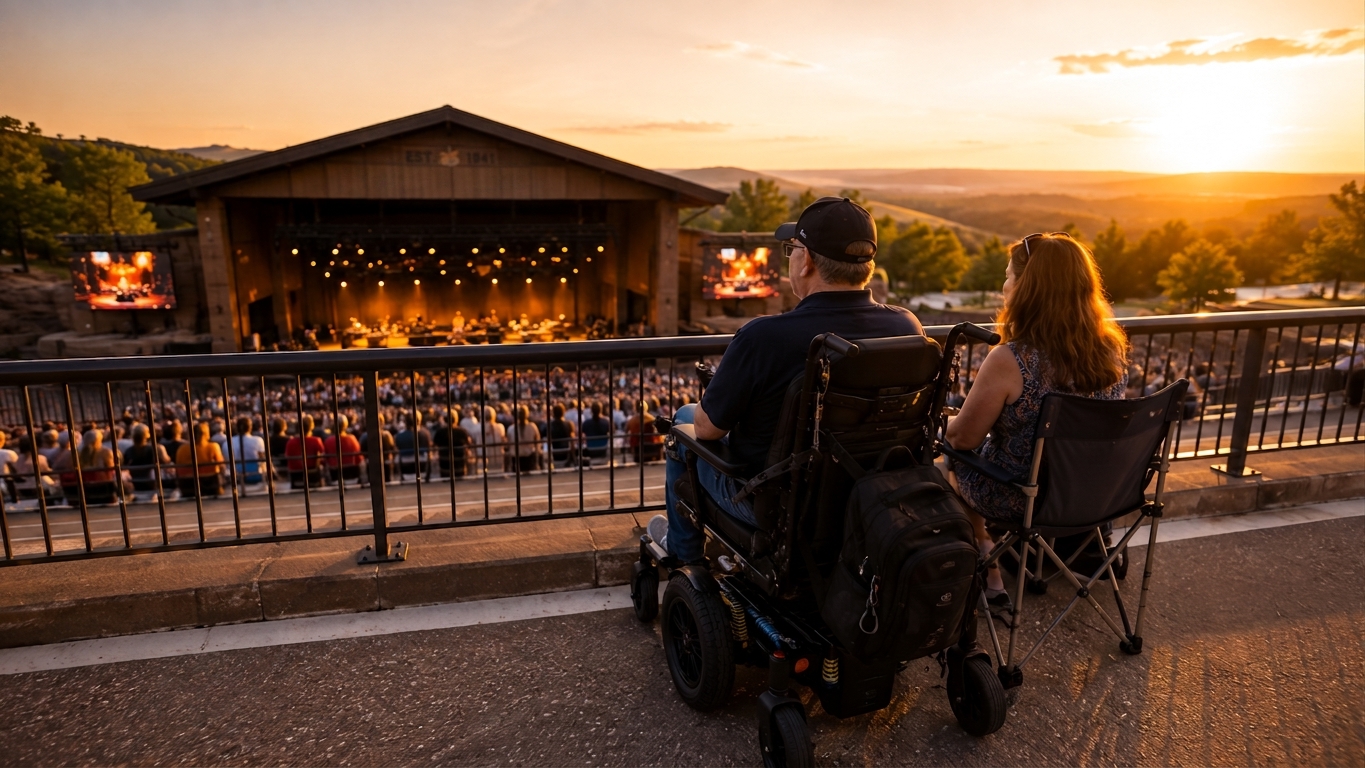
Summer concert season has a particular kind of magic. The sky goes orange behind the stage, the crowd knows every word, and the set list is one you’ve been waiting all year to hear live.
For wheelchair users, an outdoor amphitheater can add a few extra logistical considerations. Large lawns may have uneven terrain, shuttle lines can eat an hour of your evening, and sightlines can vanish the moment the crowd stands up.
None of that is a reason to skip the show. It’s a reason to know the venue’s layout before you buy the ticket. In this guide, we’ll walk through the amphitheater’s seating, lock in accessible parking close to the gate, and coordinate with the venue ahead of time, so you can focus on the singalongs.
.
Decoding Amphitheater Architecture: The Sightline Challenge
Outdoor amphitheaters vary in layout, seating style, and crowd height, all of which can affect how clearly you can see the show.
Line-of-Sight Over Standing Crowds (ADA Standards)
At a summer concert, the best seat isn’t just about being close to the stage. It’s about making sure your view stays clear when the headliner walks onstage, and the entire crowd gets to its feet, phones recording and enthusiasm operating at maximum volume.
Under ADA Standards, wheelchair seating must have lines of sight over standing spectators in front of them. Accessible seating also needs to provide choices of locations and viewing angles that are substantially equivalent to those available to others.
When you call the box office, don’t simply ask, “Do you have wheelchair seating?”
Ask:
- Is the wheelchair space elevated or positioned to provide a clear view over standing spectators?
- Is the location on a riser, terrace, or cross-aisle?
- What is directly in front of the wheelchair space?
- Will people standing in the area immediately ahead block the stage?
- Are there other accessible seating locations with different viewing angles?
The ADA requires wheelchair spaces and companion seats to be integrated into the seating plan rather than segregated from the audience. This includes people who use wheelchairs or other mobility devices, as well as people who cannot climb steps or walk long distances because of significant arthritis or severe respiratory, circulatory, or cardiac conditions. With those details confirmed, you can choose a location that gives you a comparable concert experience, not just a technically compliant one.
Lawn Seating vs. Integrated Fixed Tiering
Amphitheaters generally offer two kinds of general-area seating: open grass lawn and fixed, hard-surface tiers.
Lawn seating looks appealing in photos, but it is not automatically the easiest option for wheelchair users. Grass can become soft after rain or feel uneven under the wheels. Even with an accessible route to the lawn, maneuvering a manual or power chair across it for an entire show can take extra effort.
A hard-surface platform or fixed tier may be preferable if you want predictable footing and a defined viewing position. If a venue only offers lawn-based accessible seating, ask whether it provides a hard-surface mat or platform for the event. Some venues do this on request, but rarely without one.
Venue Parking & “Last Mile” Arrival Logistics
When you are planning to attend a concert, you also need to consider where you’ll park, how far you’ll travel to the entrance, and whether the route works well with your mobility equipment.
Securing Dedicated Van-Accessible Parking Passes
Wheelchair van venue parking is almost always limited, with spaces often available on a first-come, first-served basis unless you request an ADA pass in advance.
Aim to secure your pass on the same day you buy tickets, as accessible spaces near the gate can fill quickly. Once that block fills, the rest get released into general parking, which may not be feasible for modified vans.
Confirm three things when you call: how far the accessible lot is from the nearest accessible gate, whether the route between them is paved, and whether that route has any curbs or grade changes.
A pass close to the entrance gate can be the difference between a five-minute roll to the box office and a half-mile trek across a gravel overflow lot.
Ramp Clearance & Tailgating Safety in Venue Lots
A parking space can look perfectly fine until you need to deploy a wheelchair ramp. That’s especially true in crowded concert lots, where people park close to access aisles or set up chairs, coolers, tents, and tailgating gear around their vehicles.
According to the Americans with Disabilities Act, van-accessible parking spaces need either a 132-inch-wide space with a 60-inch access aisle or a 96-inch-wide space with a 96-inch access aisle. Van spaces and the routes serving them also require 98 inches of vertical clearance.
If you’re renting a wheelchair-accessible van for a concert, consider its layout. A side-entry ramp requires adequate space beside the vehicle to deploy it. Rear-entry vans need clearance behind the vehicle instead, which can be safer in lots where cars are angle-parked nose-in with only a narrow walking lane between rows.
For an evening concert, also consider lighting. A route that feels straightforward at 5 p.m. may be considerably different when thousands of people are leaving after dark.
Like what you’re reading? Subscribe to our newsletter and get new updates directly to your inbox.
Step-by-Step Box Office & Venue Coordination
Don’t wait until you’re standing at the entrance trying to explain your requirements to an overwhelmed staff member. Instead, reach out to the venue’s access coordinator at least 72 hours ahead of showtime and cover:
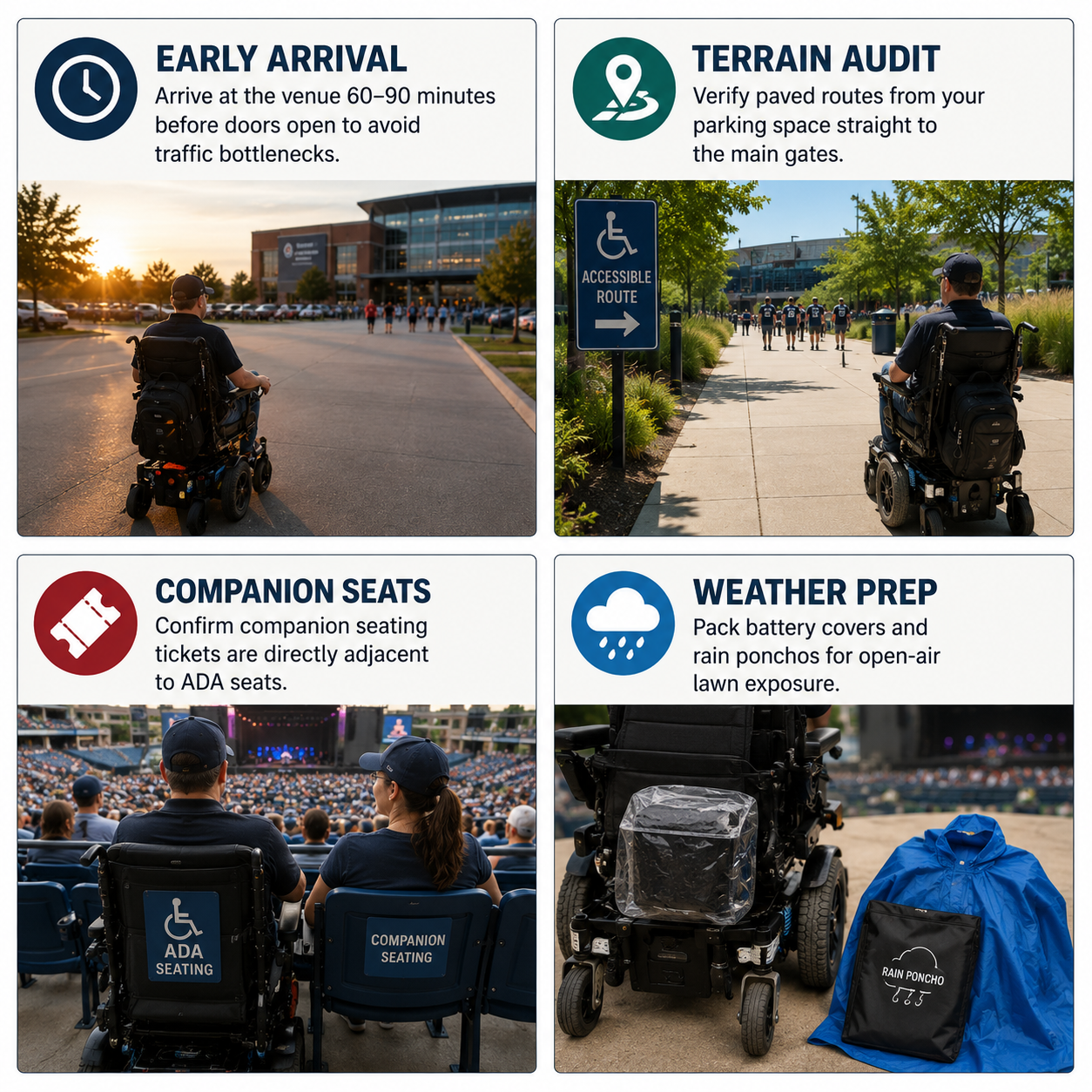
- Companion seating. Confirm the companion seat is directly beside the accessible seat, not several rows back or across an aisle. Some venues sell companion seats separately, and availability can drop quickly for popular shows.
- Shuttle service. If you’re parking in a remote lot, ask whether accessible shuttles run on a schedule or on request, whether they accommodate your mobility device, and how long the wait typically runs before and after the show.
- Restrooms and charging. Ask where the nearest accessible restroom is relative to your seating section. If you use a power wheelchair, ask them about the designated charging outlets on the concourse. Availability varies by venue, so don’t assume one will be provided.
Write down the coordinator’s name and direct line. If something is different when you arrive, having a specific person to ask for at will-call can save a lot of standing around.
What to Do When the Concert Starts?
Once the concert starts, concourse areas get busier, lines grow, and moving between your seat and other parts of the amphitheater can take longer. If you want to grab food or a drink, check which concession stand is closest to your seating section and look for one with enough space to approach the counter. If there are multiple options, a less crowded stand farther from the main entrance may be easier to reach.
Want to grab a tour shirt before everyone else grabs the good sizes? Check the merchandise stand before the headliner takes the stage.
Merchandise areas can have narrow aisles, temporary barriers, and crowds around the tables, so ask staff which stand has the most accessible setup to check out the display area.
And if you need to stop to check your phone, adjust your equipment, or regroup with your party, look for a wider section of the concourse away from the main pedestrian flow. It gives you a little breathing room without having to dodge a steady stream of concertgoers.
The Ultimate Outdoor Concert Readiness Checklist
Concert day should involve singing and vibing with your favorite artist, not solving a transportation puzzle in the parking lot.
Use this quick checklist before leaving:
- Arrive 60–90 minutes before doors to beat the main traffic bottleneck and get a calmer run through the accessible gate.
- Check the actual terrain between the parking area and the gate rather than relying solely on a map. Pavement, gravel, and grass all behave differently under a chair, and it’s better to find out before showtime than during it.
- Pack for an open sky. A poncho and a cover for battery or electronics matter more at an amphitheater than an indoor venue, since there’s often no covered fallback if weather turns.
- Confirm your accessible parking instructions and entrance before leaving home.
- Keep your venue access coordinator’s name and phone number handy.
- Plan your exit before the encore. Post-show crowds moving through unlit walkways and parking fields are the riskiest part of the night. Leaving a song or two early, or waiting out the worst of the crowd, is often the more comfortable call.
Enjoy the Ultimate Summer Show with Wheelchair Getaways
Summer concerts are worth the planning, whether you’re following a legendary rock band, catching a country favorite, or singing every word with your favorite pop artist. While wheelchair accessible outdoor amphitheaters can offer excellent views and accessible seating, you still need reliable transportation to make the evening easier.
Wheelchair Getaways offers accessible vehicles featuring lowered floors, power ramps, and secure tie-down systems, giving you more flexibility when the venue is outside your immediate area. Don’t forget to ask about our current rental deals and discounts when you book, especially if you’re planning a multi-stop tour run or a longer road trip to a festival circuit.
Call us at (855) 419-4335 or fill out our online form to lock in a rental for your next show. Then all that’s left is getting to your seat, turning up the volume, and enjoying the concert.